History
The Big Mac started from humble beginnings, debuting on April 22, 1967 from an idea to make a more satisfying burger.
The Big Mac was created by Jim Delligatti, who operated several McDonald's restaurants in the Pittsburgh area. It was created in the kitchen of Delligatti's first McDonald's franchise, located on McKnight Road in suburban Ross Township. The Big Mac debuted at the McDonald's owned by Delligatti in Uniontown, Pennsylvania, on April 22, 1967, selling for US$0.45 (equivalent to $4.11 in 2023). It was designed to compete with Big Boy Restaurants' Big Boy hamburger. Eat'n Park was the Pittsburgh area's Big Boy franchisee at the time. The Big Mac proved popular and it was added to the menu of all U.S. McDonald's restaurants in 1968.
War veteran Delligatti was no stranger to the fast-food industry – he'd worked in several drive-in joints in California following the Second World War –and he ultimately went on to open just shy of 50 McDonald's stores across the state of Pennsylvania.
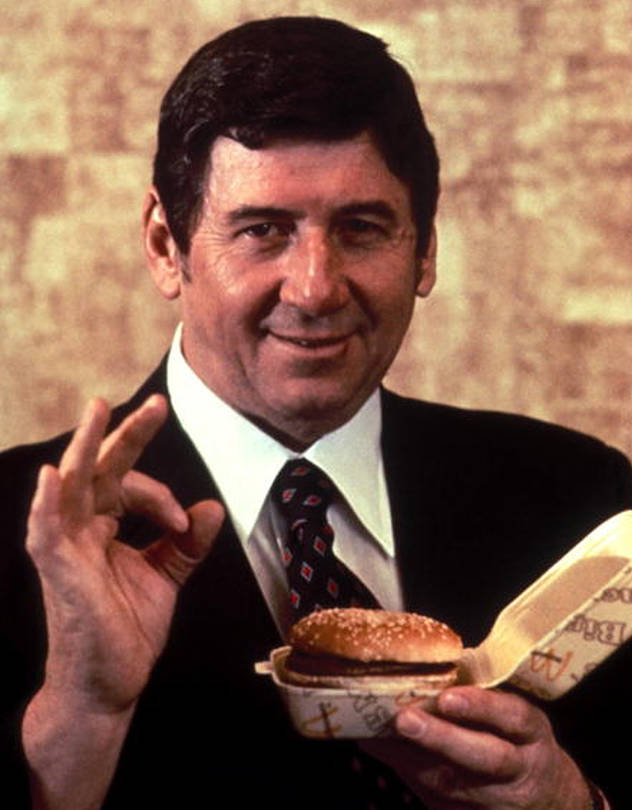
Jim Delligatti and his famous Big Mac
After a decade of being in business, master franchisee Delligatti came up with a smart plan to keep punters pouring in. His key customers were male workers from the nearby steel mills and, after a hard shift, they reportedly weren't satisfied by the smaller burgers Delligatti had to offer (the classic cheeseburger pictured, for example). Taking inspiration from the whopping sandwiches sold at diners nearby, Delligatti developed the idea for a teetering "double-decker" burger.
Though it's hard to believe given the Big Mac's status today, the mighty burger wasn't a hit with McDonald's bosses at first. They were reluctant to stray from their tried-and-tested – and immensely popular – hamburgers, and at first prevented Delligatti from rolling the creation out in his store. But Delligatti wasn't going down without a fight, and his persistence ultimately led to a change of heart. McDonald's top dogs had given Delligatti the green light by 1967.
There was one condition: Delligatti could whip up his whopping hamburger, but only if he made it with ingredients and products that were already part of the McDonald's portfolio. Ever the maverick, though, Delligatti eschewed the restaurant's existing bread in favour of a double-sliced, sesame-seed-topped bun sourced from a local bakery.
The Special Sauce
Delligatti spent a few weeks fine-tuning his recipe – including developing the burger's tangy, creamy, signature 'special sauce' – and was ready with his titanic creation by 1967. He began selling the burger – made up of two beef patties, the 'special sauce', cheese, pickles, onions and lettuce, cased together in the sesame-seed bun – at his Uniontown store that same year. It went for 45 cents a time.
The Namesake
The Big Mac wasn't always the 'Big Mac' though. The burger began its life under several decidedly less catchy names, including the Blue Ribbon Burger and The Aristocrat. Young advertising secretary Esther Rose, a 21-year-old advertising secretary who worked at McDonald's corporate headquarters in Oak Brook, Il, is widely credited as the brains behind the burger's eventual and enduring name: the Big Mac.
Big-Time Success
The beastly burger was a roaring success, and Delligatti’s franchise thrived. And, in a complete 180, McDonald's bosses decided to roll out the Big Mac at stores across the country. In 1968, just one year after Delligatti began selling the burger at his own stores, the Big Mac was made available all over the States.
With the Big Mac enjoying something of a cult status in America, it wasn't long before it found its way across the pond too. It not only graced international menus, but also found its way onto advertising posters, being proudly described as "a meal disguised as a sandwich". The "hot and hearty" Big Mac became a favourite the world over.
While today's Big Mac is almost identical to what it was in the 1960s, the burger's famous special sauce has had some tinkering over the years. It's often dubbed a closely guarded secret, but the basic recipe of the sauce – which includes mayonnaise, sweet-pickle relish and yellow mustard – has actually been shared by McDonald's chefs online over the years. Originally two versions of the sauce existed, but the recipe was finessed into a single, mouthwatering recipe in 1972. It was altered once more in 1991, but had returned to its original glory by 2004.